Saturday, July 3, 2010

The Case of TDL3 Rootkit


Let us check out the new facilities of Hypersight Rootkit Detector using a sample of TDL3 rootkit. This epic rootkit was a nightmare for virus analysts recently.

Testing environment: Windows 2003 SP2 system, Intel Core 2 Duo E6700 processor. The initial conditions of the test: Hypersight RD 1.0.1233.5523 beta is installed, PC has been rebooted and “Start” button is pressed inside of the UI.

After starting the sample we can see that Hypersight has found covert code execution on the processor.

Covert code detected by Hypersight

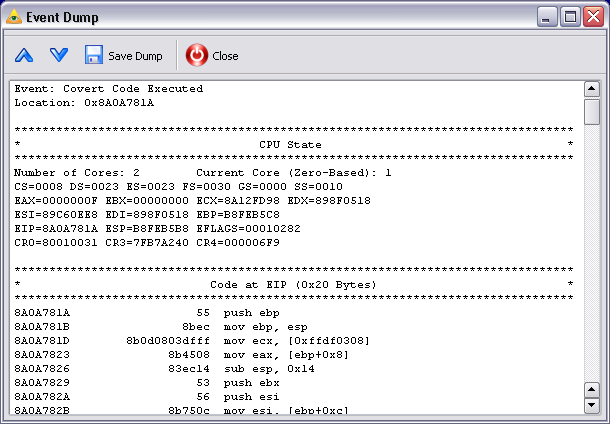
We can observe several events. Each event is the execution of covert code on a single page (pages are 4096 bytes long in IA32/IA32e architecture). After pressing “Save All” button we can save the rootkit’s profile of execution to the compresed binary dump. Also we can press “View Dump” button and view each event dump in the separate window. Each dump contains couple of memory regions with the code and the stack, processor state and loaded kernel modules at the moment of event occurring. The format of event dumps is open. We will publish open source tool for decoding dumps soon.

Dump of code launched from TDL3 dropper

If you have reverse engineering skills, you can check out the stack for return address and see that the code has been launched from the newly loaded kernel module (3.tmp).
Another typical dump: a hook installed on IRP callback. In this case, one of registers in the dump usually points to driver object (DRIVER_OBJECT) MajorFunction callback of which has been hooked.
Dump of IRP hook installed by TDL3. ESI points to DRIVER_OBJECT structure

For sure, TDL3 is not the only rootkit which can be detected and analyzed. Hypersight Rootkit Detector provides generic detection of kernel mode rootkits. We'll keep you in touch with the information of all the other rootkits as soon as we have more details.

Detection of Rootkits: the Next Step

Everyone knows what a great challenge are modern rootkits. Millions of computers worldwide are infected with rootkit-based bots. Modern anti-virus and anti-rootkit solutions are useless to detect most of them. The common approach in recent years is the development of particular solutions detecting certain versions of some rootkit. Typically, these solutions do not work after the appearance of a new version of the rootkit.

Our company has conducted extensive research in the field of rootkit detection past 3 years. We concluded that the detection of rootkits is possible using virtualization technologies. The recent hardware virtualization technology Intel VT-x and AMD-V have facilitated this task.

We have designed Hypersight Rootkit Detector. It was the first Windows-based solution of this class. The first version of the program could intercept only a few actions, typical for rootkits: modification of control registers, modification of executable code, turning hardware virtualization on. It makes possible to detect many types of rootkits. Nevertheless, this was not enough. Detouring these interceptions was still possible from the rootkit side.

Now we are proposing a more generic criterion for detection of rootkits. For all rootkits, regardless of the technologies used (SSDT hooking, DKOM, DKOH, Shadow Walker, splicing), there is one common trait. They are executed on the processor. We have implemented the algorithm which performs basic checks on the code prior its execution. The technology was named Fast Code Test (FCT). The code executed at the privileged level, subjected to a number of basic checks. If checks fail, notification about undesirable activity is generated.

Currently, checks are quite simple. The code running outside of loaded drivers, kernel and HAL is considered as suspicious. This approach makes possible to detect the absolute majority of the currently known rootkits. Recent rootkits tend to run “covert” code in kernel non-paged pool in order to avoid detection by memory scanning. This is the activity detected by FCT.

Signature scanning and code whitelisting will be the further steps in the development of Fast Code Test.

Fast Code Test significantly complicates the task of writing "undetectable" rootkit. We plan to develop this technology in terms of productivity and efficiency. We hope it will help people to analyze new rootkits faster and more efficiently.

Sunday, June 22, 2008

Catching Blue Pill

HVT-based rootkits became a new headache for anti-malware vendors since their appearance in 2006. There are no working HVT rootkits yet (only PoC implementations), but who knows what happens later? It is possible (not easy though) to create a HVT rootkit with extra functions such as keylogging, HDD access, network communication or traffic interception. Plenty of helpful source codes are available for a rootkit creator (such as open source hardware drivers, open source operating systems etc). VT-based rootkits are very hard to detect when they are already installed. Moreover, no existing anti-malware product is capable of preventing a VT-based rootkit from installing.

So what is the solution? It is possible to detect HVT rootkits by monitoring indirect results of their activity. The advantages and disadvantages of this approach are well described in Joanna Rutkowska’s articles. The methods described are not generic and can be cheated by a rootkit (e.g. Blue Chicken method). Furthermore, they don't allow unambiguos detection of a rootkit since they don't give any access to the rootkit’s body.

We have found another approach. Here is its brief description.
The idea is to intercept a hypervisor's start by another hypervisor (let’s call the latter a Virtual Intrusion Prevention System, or VIPS). When any hypervisor (malicious or legitimate) starts, it turns VM root mode on. This event can be easily intercepted by a VIPS. So what's next? There are 2 ways to handle this event: blocking a hypervisor completely, or allowing it to work through emulation.

The first way consists in emulating a PC with disabled HVT feature in BIOS. This will block a HVT rootkit from working.

The second way consists in allowing a hypervisor to work through emulated hardware virtualization (or nesting). This should be done for legitimate virtualization software.

In both cases (blocking or emulating), a VIPS intercepts a hypervisor at the moment it tries to start. VIPS can read the hypervisor’s body and analyze it. A notification message can be shown.

At present only the first case is implemented - preventing a hypervisor's start. The second case is currently in development. We hope it to be ready soon.
To check the new feature of the Hypersight Rootkit Detector, we have used the CHKSVMX tool from Invisible Things Lab. When we run CHKSVMX on a PC with installed Hypersight RD, a message from HRD appears that a hypervisor’s start has been blocked. CHKSVMX tool also reports a disabled HVT feature (see images below).

Detecting and blocking hypervisor on Intel VT-x

Detecting and blocking hypervisor on AMD-V

We didn’t test the new HRD feature with the Blue Pill because the Blue Pill is currently implemented on x64 platform only. When we create a x64 version of Hypersight, it will be detecting the Blue Pill as well. The opportunity to catch a Blue Pill does exist and we have proven it.

The approach described can be successfully implemented in anti-malware software to achieve HVT rootkits blocking. It can also be integrated with virtualization software. The real BP stopping aproach can demotivate malware creators from exploring the area of HVT rootkits (mind that the creation of a full-scale HVT rootkit is a big challenge comparable to development of a mini-OS).

Sunday, January 27, 2008

Detecting and blocking Shadow Walker

Recently we got a sample of code that conceals itself in the memory by modifying the page table (a technology known as Shadow Walker). Shadow Walker is based on the fact that Intel IA-32 CPUs have 2 address-translation caches: for code pages (ITLB) and for data pages (DTLB). It works like this. A page fault handler (int 0x0e) is intercepted, and then the pages of concealed code in the page table are marked as missing pages. After that, any attempts to access those pages for read, write or execute lead to page faults. The page fault handler checks requested access to page: either execution or access to data. In the case of execution, the handler loads ITLB with a original code page. In the case of access to data, the handler loads DTLB with a fake page. Thus, using desynchronization of ITLB and DTLB, Shadow Walker conceals its presence in the memory.

We tried to run Shadow Walker on a computer with installed Hypersight RD 0.3.543.


Test 1. Detecting

In this test Hypersight RD worked with the default settings. By these settings, modifications of the page table are allowed and recorded. After running Shadow Walker we noticed the window Hypersight RD had started to scroll messages on writing to page table. Hypersight RD window had been looked as follows.


The figure shows that a code that doesn’t belong to any of the kernel modules, writes to the page table. This activity is performed by the page fault handler, marking concealed pages as present or absent when loading them to TLB.


Test 2. Blocking

For this test we have turned on the option "Disable page table modification (unsafe)". This option turns on blocking of the page table modification by untrusted code.


Then Shadow Walker was loaded. Hypersight RD window had taken the following form.


You can see that Hypersight RD blocked Shadow Walker’s attempts to modify the page table. Subsequent work of Shadow Walker became impossible since Shadow Walker was unable to mark pages of code as missing. Thus, the Shadow Walker had been completely blocked.

Tuesday, December 11, 2007

Renaming

We have renamed our product code-named Raidho Rootkit Detector to Hypersight Rootkit Detector. Web site is coming soon.

Monday, November 19, 2007

Raidho Rootkit Detector 0.1 alpha

We have designed Raidho Rootkit Detector 0.1 alpha. It works on CPUs with VT-x technology supported. Program detects presence of Rustock rootkit by intercepting its attempts to patch the kernel code.

Tuesday, November 13, 2007

Let's begin

Okay, now we started this blog. All information about our future projects will be posted here.